
 Everything Indian
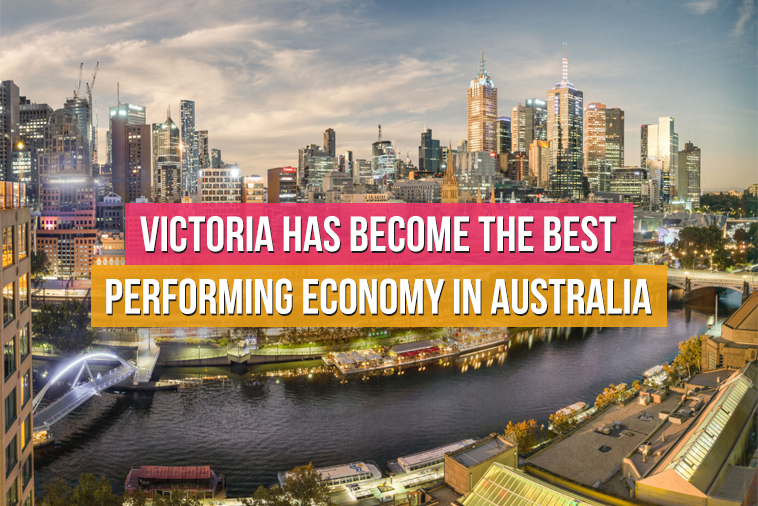
Victoria has been named the best-performing economy for the first time in more than two years, unseating Tasmania.
According to the most recent quarterly CommSec State of the States survey, Victoria has once again been placed at the top because of a robust jobs market and consumer spending.
According to the CommSec study, Victoria experienced the highest rate of job growth among all states and territories in June, adding more than 28,000 new positions and pushing the state’s total labour force to a record high of more than 3.54 million.
The March quarter had a state-wide increase in retail spending of 18.5% over the ten-year average.
Furthermore, according to recent data from the Australian Bureau of Statistics (ABS), Victoria’s unemployment rate is at 3.2%, close to a 50-year low.
Performance Of Other States
Tasmania, which held the top spot for the past nine quarters, fell to third place behind the ACT.
Queensland ranks fourth, but chief economist Craig James noted that there wasn’t much separating the top four.
“Victoria leads the way for two of the eight economic indicators. But he said that shows how even the rankings are, the ACT and South Australia also lead other economies for two of the eight indicators,” he said.
“Queensland had yearly growth rates that exceeded the national average on all of the eight measures when looking at annual growth to gain a guide on economic momentum.”
West Australia ranks fifth, followed by South Australia and then NSW.
There was a massive gap between NSW, the seventh-ranked and the Northern Territory, the eighth-ranked.
Instead of explicitly comparing each economy to one another, the report compares each state’s quarterly performance to its decade averages to measure economic momentum.
Overall, Mr. James asserted that the influence of Covid and interest rate increases would vary the performance in the future.
In terms of future economic performance, he said a lot would rely on how economies react to a period of increasing interest rates and how they are impacted by an increase in the number of Covid-19 cases.
The analysis was released before Wednesday’s announcement of the inflation data for the June quarter.
Treasurer Jim Chalmers stated last week, “We will be revising the predictions for inflation, and that will make the actual wages situation worse.”
Earlier this month, the RBA (Reserve Bank of Australia) raised the interest rate again, from 0.50 percent to 1.35 percent. When the central bank meets in August, they anticipate a further 0.50 percent increase.


GIPHY App Key not set. Please check settings